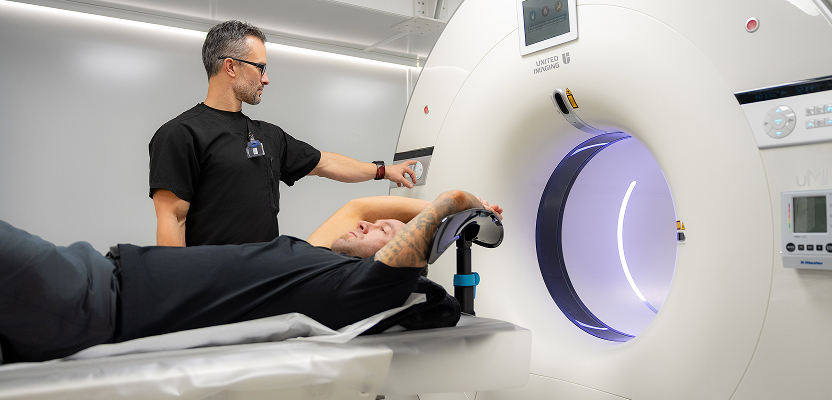
Mobile PET/CT companies bring a staffed PET/CT unit to your practice on scheduled days, and the proposals look alike until you ask about the scanner, the isotope supply and who reads the studies. We've run our own mobile PET/CT and SPECT units for cardiology practices since 2008. This is the list we'd want a practice administrator to have before comparing us with anyone else.
What mobile PET/CT companies provide, and what "included" usually leaves out
Every provider says the service is turnkey. The word covers a lot of ground, so pin down what's in the fee and what lands on your staff.
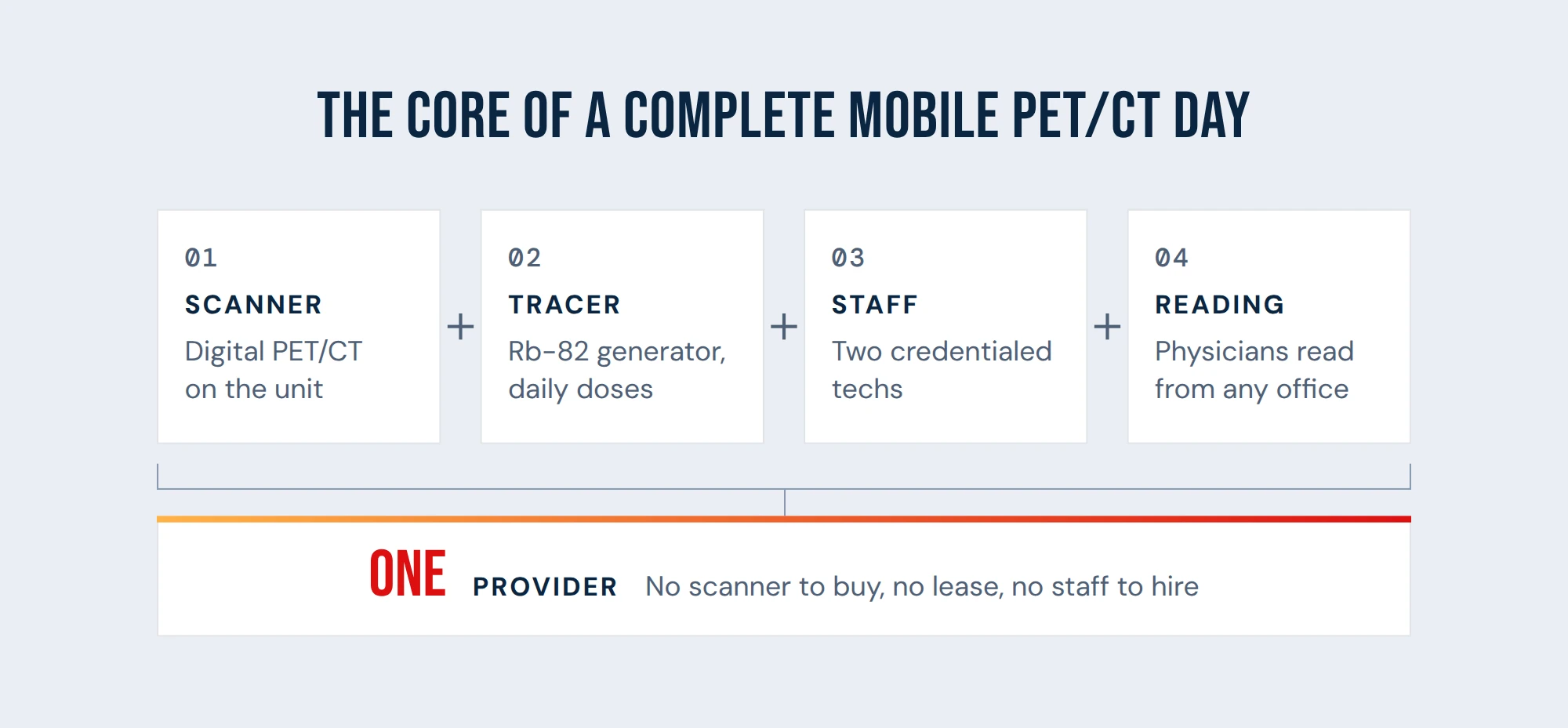
A complete mobile PET/CT service includes the unit and scanner, the Rb-82 generator and daily doses, two credentialed technologists, stress-agent supply, image processing, a reading platform your physicians log into, and a scheduling contact who owns the calendar. It should also include the site walk before your first day and the paperwork that follows every scan.
The items that get left out, in our experience: the stress agent, the reading platform license, prior-authorization support, and anyone who picks up the phone when a patient no-shows and a dose is wasted. Ask for the fee sheet with each of those named. If a line says "available", it isn't included.
Rental, lease or staffed service: which one you're actually being offered
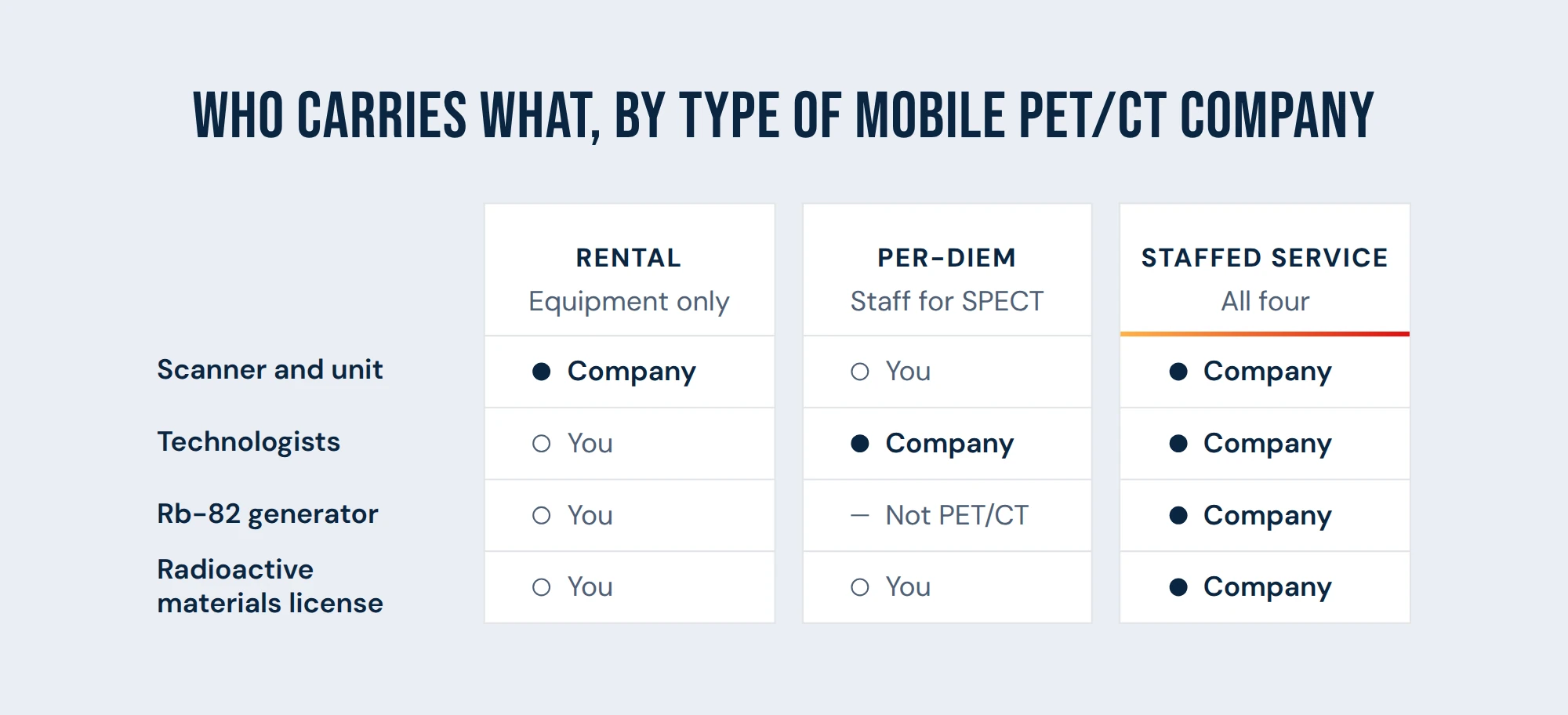
Three different businesses answer to the phrase "mobile PET/CT company", and they put very different work on your practice.
- Equipment rental or lease. You get a trailer with a scanner. You hire the technologists, hold the radioactive materials license, buy the generator and carry the maintenance contract. The monthly number looks small because most of the cost moved to your payroll.
- Per-diem technologist staffing. You already own a camera and need people to run it on certain days. Useful for practices with an idle SPECT room, not a way to add PET/CT.
- Staffed mobile service. The company brings the unit, the staff, the isotopes and the licenses. Fee structures vary from one provider to the next, so ask how yours is built. This is what most cardiology groups mean when they search for a provider, and it's the model VIP Imaging runs.
If a proposal doesn't say which of the three it is in the first paragraph, ask before you read the rest.
Eight questions to ask any mobile PET/CT provider
- What scanner is on the unit, and what year was it installed? Ask for the make and model in writing. Our units run United Imaging uMI 550 digital PET/CT scanners. Some companies still run a ten-year-old scanner. It still produces a bill; it doesn't produce the same image.
- How many Rb-82 generators do you hold, and who supplies them? Generators are ordered months in advance. A provider adding units faster than its generator allocation will cancel days. Ask what happened the last time a generator shipped late.
- Who reads the studies, and how fast? Your physicians can read on the cloud platform, or the provider's reading physicians can. Get the turnaround in hours, not "prompt". Ours is 12 hours.
- How many technologists come with the unit, and what are their credentials? Two per unit is the working minimum: one to run the scanner and one to manage the patient and the stress protocol. Ask for NMTCB or ARRT(N) certification and current CPR, BLS and ACLS.
- Which licenses, accreditations and compliance programs are in the company's name, not yours? The radioactive materials license, IAC or ACR accreditation, the DOT drug and alcohol program for drivers, and per-state technologist licenses. If any of these are expected to sit under your practice, that's a lease with extra steps.
- What does my site need? Pad dimensions, power requirements, shielding, and how the unit connects to your PACS. A provider who can't answer this on the first call hasn't done many site walks.
- What happens on a no-show? A wasted Rb-82 dose costs money. Find out whether you pay for it, the provider absorbs it, or the schedule is built to avoid it.
- Can we run a day before we sign? The answer tells you more than the deck does.
How to check a company's compliance history in ten minutes
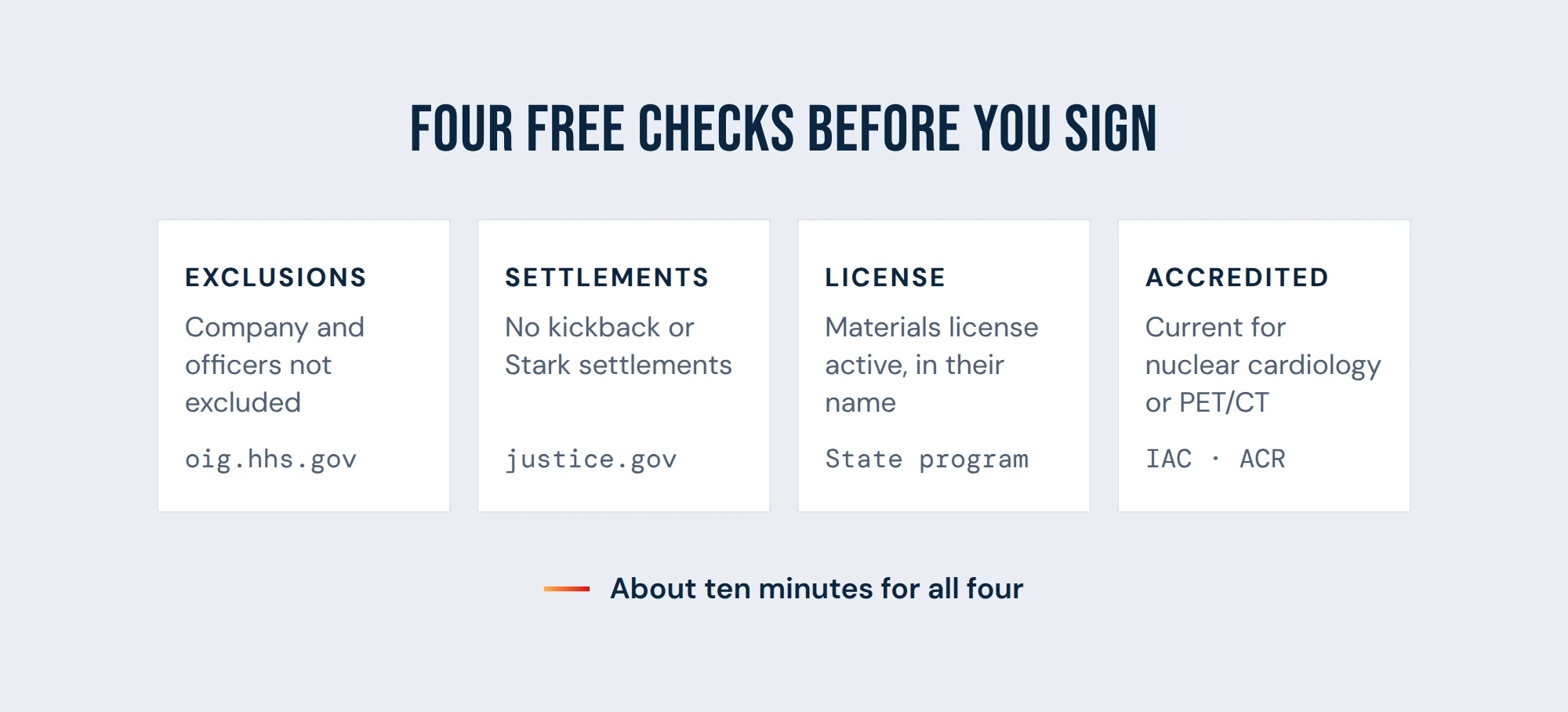
Mobile imaging touches Medicare billing, radioactive materials and patient transport, so the compliance record is public and deeper than most vendors' references. Four searches, all free:
- OIG exclusion list (exclusions.oig.hhs.gov): search the company name and its officers. An excluded party can't be paid with federal healthcare dollars, and neither can a practice that knowingly contracts with one.
- Department of Justice press releases (justice.gov/news): search the company name plus "settlement". Read the underlying conduct, not just the headline number. Kickback and Stark settlements in mobile imaging usually involve how the provider structured its deals with practices, which means the practices were part of the record.
- Your state radiologic health program: in California, the Radiologic Health Branch lists radioactive materials licensees. Confirm the license is active and in the provider's name.
- IAC or ACR accreditation lookup: confirm the facility is accredited for nuclear cardiology or PET/CT, and that the accreditation hasn't lapsed.
We built this into our own onboarding because practices started asking. It takes ten minutes and it's the only part of vendor selection that can't be fixed after you sign.
Scanner age, Rb-82 supply and reading turnaround
These three decide the quality of a mobile PET/CT study and the reliability of the schedule, so they deserve their own section.
Scanner. Digital PET/CT scanners resolve smaller perfusion defects and complete a study in less time, which is how a rest-stress protocol fits into a 45-minute patient visit. Ask for images from the provider's actual unit, not the manufacturer's brochure.
Rb-82 supply. Rubidium-82 comes from a strontium generator that decays on a schedule. Suppliers plan allocations three to four months out. A provider's ability to add days for your practice is bounded by its generator count, so ask how growth is handled before you're the practice whose day gets moved.
Reading. Two things matter: where the images go, and who's accountable for the report. A cloud reading platform your physicians can open from any office, plus a named turnaround, is the standard. If the provider offers reading physicians, ask who pays them and how the report reaches your EHR.
What your site needs for a mobile PET/CT unit: pad, power, PACS
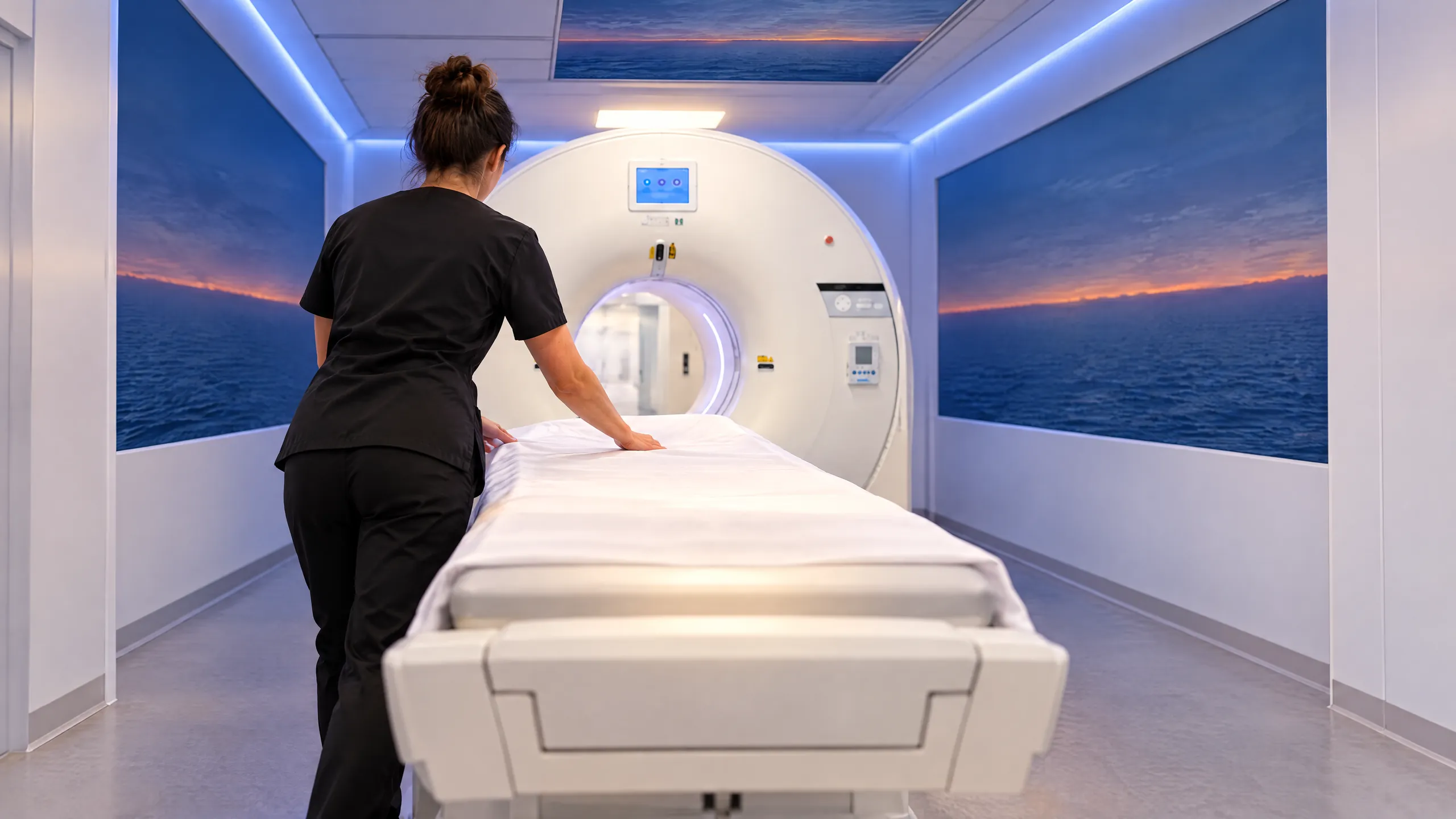
A mobile PET/CT unit needs a level pad, a dedicated power connection and a route the trailer can turn into. Shielding is built into the unit. Our team walks the site with your office or property manager before the first day and handles the layout.
On the IT side, the studies need to reach your PACS or the reading platform. Get the integration plan in writing, including who configures it and what your IT contact has to do. This is a half-day task when it's planned and a two-week delay when it isn't.
What a no-commitment trial day looks like
Our process runs in this order: an office visit and proposal, a site evaluation, a trial day, then a schedule built around your referral volume. The trial day is a real mobile PET/CT imaging day with real patients, run by the same technologists who'd staff your account. You see the patient flow, the front-desk handoff, the image quality and the paperwork before any contract is signed.
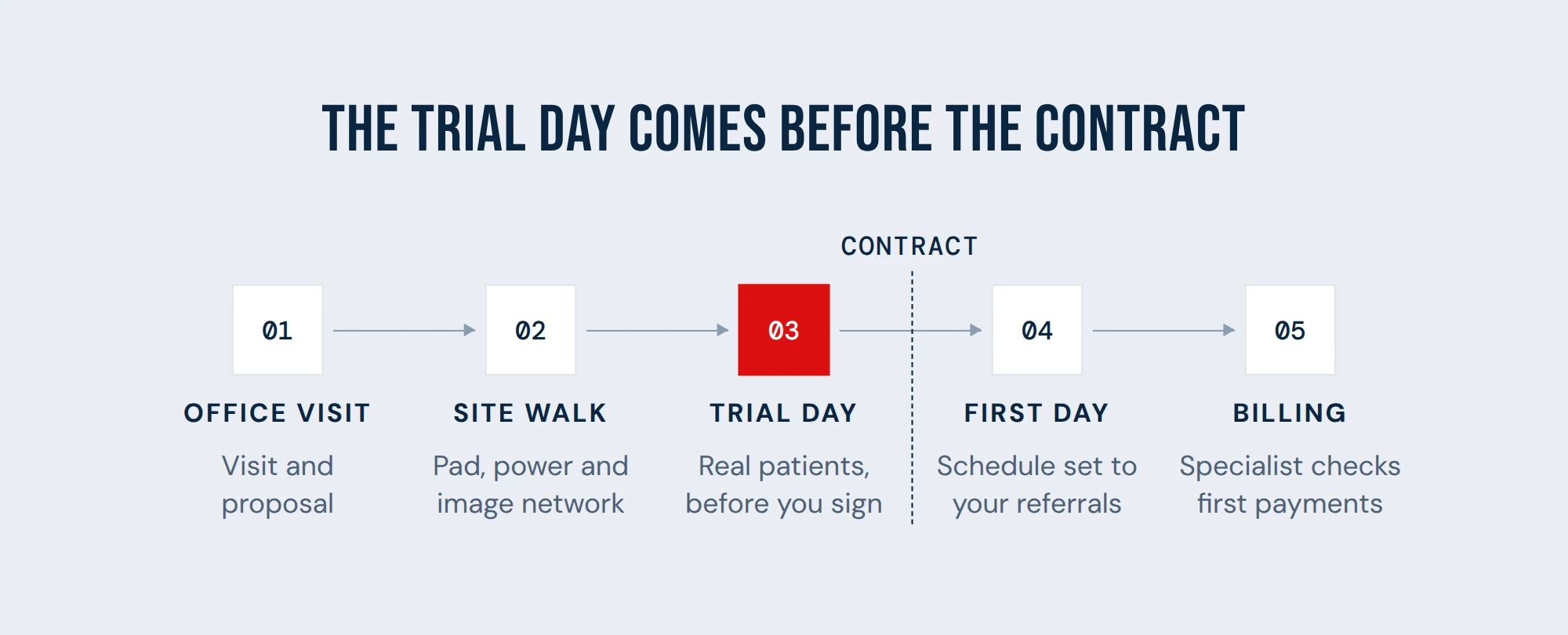
After the first regular day, our reimbursement specialist reviews your first EOBs with your billing staff so the codes and payments match what was projected. Practices we work with have increased imaging volume 25 to 50% after adding PET/CT.
Mobile PET/CT companies serving California and Texas
VIP Imaging runs mobile cardiac PET/CT and SPECT units from Anaheim, California and McGregor, Texas. In Southern California we serve Los Angeles, Orange, Riverside, San Bernardino, San Diego, Imperial and Ventura counties. In Texas we cover Central Texas, Austin, Houston and Dallas–Fort Worth. See the service areas page for each region.
Patient visits run about 45 minutes. There's no scanner to buy, no lease and no staff to hire. Your physicians read the studies, or we read them for you.
Bring mobile PET/CT to your practice. Tell us your offices and your monthly stress-test volume. We'll show you a schedule and a revenue estimate.
Get a schedule and estimate · (877) 484-7462
Frequently asked questions
Is this a mobile PET/CT rental or a service?
A service. VIP Imaging brings the staffed unit, the Rb-82 generator, the licenses and the reading platform on scheduled days. There's no equipment lease and nothing for your practice to staff.
How do I compare mobile PET/CT companies on price?
Ask each provider for a fee sheet with the stress agent, reading platform, technologists and prior-authorization support named as included or excluded. Fee structures differ, so compare the all-in cost against your payer mix for CPT 78431 and 78434, not one provider's headline number against another's.
How fast can a mobile PET/CT company start at my practice?
Often the same week you sign, once the site walk is done. Generator allocation is the usual limit; ask any provider how many units and generators they hold.
Do we need our own radioactive materials license?
Not with a staffed service. The license, the accreditation and the technologist credentials sit with the provider. With an equipment lease, they sit with you.